2025 Apple Product Tier List
The annual 2025 Apple Product Tier List, where I rate everything Apple released in 2025.
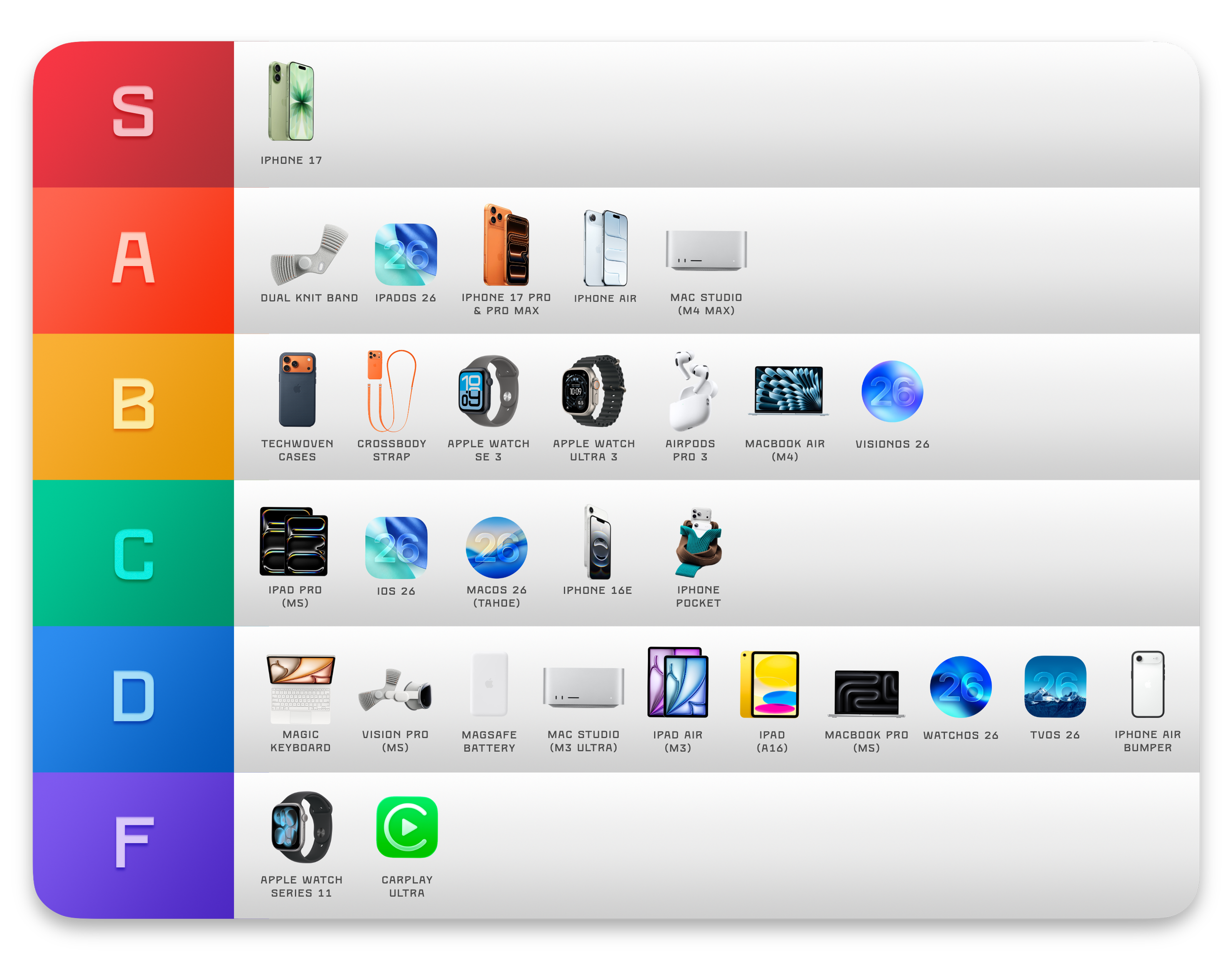
Welcome to the 4th annual Apple Product Tier List, my yearly rundown and ranking of every Apple hardware and software product announced and released in 2025. This year, I’m grading 30 products in total, spanning everything from the iOS 26 Liquid Glass redesign to the iPhone Pocket, iPhone 17 Pro, and the M5 Apple Vision Pro.
Tier System Details
Ranking System Explained
If the product is brand new, like the iPhone Air, I rank it based on my opinion of it, its value (including cost and utility), and the vibes from the tech ecosystem. If the product is an upgrade, like the M5 MacBook Pro, its ranking is based on comparing it to its previous generation (i.e., the M4 MacBook Pro) or to current competing Apple products (M4 MacBook Air, M4 Pro/Max Pros). If a product is ranked low, it doesn't mean it's a bad product (although it could be); it might just mean that its value compared to the previous iteration didn't make it a compelling update. Case in point: AirPods Pro 2 with Lightning were S-Tier in 2022, but the 2023 USB-C refresh dropped to C-Tier simply because it was such a small change.
TIER SYSTEM EXPLAINED
The ranking system I am using is a pretty conventional hierarchical system where things are put into one of six letter grades:
S-Tier: Exceptional, the best of the best, flawless.
A-Tier: Excellent, great to nearly perfect.
B-Tier: Good, above average.
C-Tier: Average but not outstanding.
D-Tier: Below average, flawed in many ways.
F-Tier: Poor, failing, or unacceptable.
DIY 2025 TIER LIST
I'm also including a link to a companion entry in The Haberdashery with files to help you create your tier ranking system for Apple's 2025 lineup. Enjoy!.
2025 Apple Product Tier List
S-Tier
iPhone 17
Announced: 2025.09.09 | Available: 2025.09.19
In 2025, the sole product worthy of an S-Tier ranking is the iPhone 17 (with a few bonus points awarded to the White and Mist Blue finishes).
For the first time, the standard iPhone finally gets an always-on ProMotion display (about time), paired with a faster chip and neural engine, tougher cover glass, and massive battery gains over the iPhone 16 (up to 40% more battery life). Add in an upgraded selfie camera, a new 48MP ultra-wide camera, a respectable 256 GB base storage, a brighter display for better outdoor visibility, native dual-video capture, updated Bluetooth (5.3 to 6), dual-frequency GPS, and probably a few things I’m forgetting.
And that’s all just the upgrade list from the iPhone 16.
The iPhone 17, much like the MacBook Air, has firmly cemented itself as the best all-around iPhone and the one I would recommend to roughly 90% of buyers. Only if you want the absolute best battery life, need a telephoto camera, crave the very best graphics for mobile gaming, or have a deep, unshakable lust for cosmically orange phones would I steer you toward the Pro. The Air, meanwhile, is for those who want a more luxurious-feeling device that hints at Apple’s future.
Not that long ago, the regular iPhone felt like a series of compromises. It doesn’t anymore. This is the best all-around package of features Apple has shipped in a standard iPhone in years.
A-Tier
Apple Dual Knit Band
Announced: 2025.10.15 | Available: 2025.10.22
When Apple rolled out its trio of M5 announcements in mid-October, one of the quieter but more meaningful updates to the new Apple Vision Pro was the introduction of a redesigned band, also sold separately, featuring adjustable top and rear straps. The rear strap is now weighted, which technically makes the Vision Pro setup even heavier.
And no, nobody was asking for a heavier Vision Pro. But in this case, the extra weight actually works in your favour. Despite being heavier on paper, I’ve found the new setup noticeably more comfortable during longer sessions. For months, people have been experimenting with hacks, third-party straps, and improvised solutions to improve comfort. This accessory finally feels like Apple directly addressing one of the headset’s most persistent complaints, and it does so surprisingly well.
iPadOS 26
Announced: 2025.06.09 | Available: 2025.09.15
iPadOS 26 represents a massive step forward in positioning the iPad as a genuinely capable computer. Window customization and manipulation have been dramatically improved. The new windowing system, from tiling and organization to resizing and layout, now feels remarkably Mac-like. A significantly better Files app, the addition of app menu bars, support for background tasks, and enhanced PDF tools finally push iPadOS into territory where I can confidently move more power-user workflows onto the iPad.
What’s more interesting is that in some areas, using iPadOS is now preferable to the macOS. Better Apple TV integration, a wider selection of apps, native Live Activities, and dedicated Health and Fitness features are still absent on macOS. And because it increasingly feels like features debut on iOS and iPadOS before expanding outward to other platforms, iPadOS benefits from refinements like a more cohesive Liquid Glass implementation than what’s sometimes found on the Mac.
iPadOS 26 is a massive step forward towards the OS a product as powerful as the iPad deserves.
iPhone 17 Pro & 17 Pro Max
Announced: 2025.09.09 | Available: 2025.09.19
This year delivered the biggest visual shake-up to the iPhone since its debut in 2007. For the first time in 18 years, there is no black or Space Grey option. Instead, Apple introduced Deep Blue and the unmistakably bold Cosmic Orange.
There is plenty to like here. The Ceramic Shield display is now three times more scratch resistant, and thanks to a larger battery paired with vapour cooling, the phones stay noticeably cooler under load while delivering significantly better battery life.
On the camera front, the new square 18 MP Center Stage selfie camera, a major 48 MP telephoto upgrade, and native Dual Capture are all excellent additions for iPhone photographers.
So why not S-Tier? The iPhone 17 Pros lose points for sacrificing some of their premium feel in favour of a more utilitarian design. While I understand the trade-offs around weight and heat dissipation, I still prefer the look, feel, and long-term durability of titanium or stainless steel over this year’s shift to aluminum. The lack of a chamfered edge around the Camera Plateau also leaves that area especially vulnerable to scratches and chips, most noticeably on the Deep Blue and Cosmic Orange finishes.
That said, I do appreciate how Apple has clearly defined its lineup this year. With a budget option (iPhone 16e), a standard model (iPhone 17), a lux model (iPhone Air), and the fully featured Pros, each device is now free to lean into its strengths rather than trying to be everything to everyone.
iPhone Air
Announced: 2025.09.09 | Available: 2025.09.19
I know I’m going to get absolutely torched for placing the iPhone Air in A-tier, let alone putting it on the same plane as the iPhone 17 Pro.
But in a world defined by year-over-year iterative updates, the iPhone Air manages something rare. It takes a familiar design and makes it feel genuinely new, fresh, premium, and, most importantly, an absolute delight to use. I love using this device. I love handling it. Months later, I’m still a little awestruck by its thinness and overall form factor.
Battery life is perfectly serviceable for most people, and anyone who wants more endurance or more camera flexibility can easily pivot to Apple’s iPhone 17 lineup. This will likely never be Apple’s best-selling iPhone. Still, nearly every review I’ve seen has taken genuine delight in what Apple created here. The most common criticism being that the iPhone Air doesn't fit their specific needs, rather than it being anything less than a phenomenal device. which is a very different kind of complaint.
M4 Max Mac Studio
Announced: 2025.03.05 | Available: 2025.03.12
Built on a more efficient 3 nm process, with higher memory ceilings, hardware-accelerated ray tracing, Thunderbolt 5, and performance gains of up to 66%, the M4 Max Mac Studio is a subtle but meaningful upgrade to Apple’s most powerful Mac.
It’s still frustrating that a machine this expensive and capable offers zero upgradeability for storage or memory beyond the checkout screen. That said, even a pretty basic config for this kind of system will remain effortlessly capable of handling complex, professional workflows for the better part of the next five years without breaking a sweat.
A-tier might be slightly generous, but being able to buy a Mac this powerful for under $2,000 is genuinely impressive.
B-Tier
Apple TechWoven Cases
Announced: 2025.09.09 | Available: ~2025.09.19
In 2023, Apple released one of its most disliked products in years: FineWoven iPhone cases. These micro-twill cases replaced Apple’s long-standing leather lineup and were promptly scorched online for how easily they scratched and stained, their high price, and their lack of a premium feel. The following year, Apple quietly abandoned the idea altogether, offering only Silicone cases in 2024.
Round two looks much better. With TechWoven, Apple revisits the concept and delivers a meaningfully improved product. These slightly textured, jacquard-loomed polyester cases are grippy, durable (mine still looks brand new), and genuinely pleasant to hold. They slide in and out of a pocket easily while still offering enough grip to feel secure in daily use.
No, they aren’t leather. But with TechWoven, Apple has clearly taken steps to make amends for FineWoven, and this time, it mostly works.
iPhone Crossbody Strap
Announced: 2025.09.09 | Available: ~2025.09.19
After recently traveling outside of North America, I was struck by just how common wearing your phone has become. Whether for safety or convenience, more and more people are making their phone part of their everyday outfit. I’ve personally always used a strap like this while traveling. Keeping my phone easily accessible helps me capture more of the trip, and the added security is reassuring if I lose my grip or fumble a shot. So having a well-designed, albeit quite expensive, first-party option to match Apple’s ecosystem is genuinely appealing.
Apple’s Crossbody Strap comes in nine colours to pair neatly with the current lineup of phone finishes and accessories. Magnets embedded in the strap (of course Apple used magnets) make adjusting the length effortless, while still being strong enough that I don’t have to worry about it slowly loosening over time.
The one awkward downside is that if you decide not to use the strap, you’re left with two dangling loops attached to the case where the strap connects, which feels a bit inelegant for an otherwise thoughtfully designed accessory.
Apple Watch SE 3
Announced: 2025.09.09 | Available: 2025.09.19
In the past, the Apple Watch SE felt firmly positioned as Apple’s budget or entry-level watch, aimed primarily at first-time buyers. With the Apple Watch SE 3, though, you could convincingly argue that this is now the Apple Watch that makes the most sense for most people.
While it still lacks some of the advanced health features found in the Series 10 and 11, such as hypertension detection, ECG, and VO₂ tracking, the SE 3 now includes an always-on display, the same S10 chip as Apple’s latest watches, sleep tracking, and more. At $250, it’s $150 cheaper than the Series 11, and unless you specifically want or need those extra health sensors, this is an excellent watch with few compromises.
Apple Watch Ultra 3
Announced: 2025.09.09 | Available: 2025.09.19
It’s been a couple of years since we last saw a meaningful update to the Ultra line, with last year limited to the addition of a Black Titanium finish for the Ultra 2.
If you’re still using the original Ultra, the battery is likely starting to feel long in the tooth, making the Ultra 3 a compelling upgrade to refresh the experience. Ultra 2 owners, however, get a bit less for their money. While the addition of a persistent second hand, a very slightly larger display (12 pixels more horizontally and vertically), and roughly six extra hours of battery life are welcome, they’re not exactly transformative.
The biggest draw for some will be the addition of Emergency SOS via satellite. That feature alone meaningfully expands where the watch can keep you connected and offers genuine peace of mind, knowing there’s another lifeline to the outside world if something goes wrong.
AirPods Pro 3
Announced: 2025.09.09 | Available: 2025.09.19
I’m going to go out on a limb and assume this will be another controversial placement. The AirPods Pro 3 are a strong successor to the AirPods Pro 2, which I used for several years and relied on heavily for travel and most day-to-day listening.
With promises of improved noise cancellation, better battery life, and enhanced dust, sweat, and water resistance, these were an easy day-one purchase.
And in everyday use, I’ve generally been happy with the AirPods Pro 3. That said, the new foam tips took longer to adjust to than I expected, and even after months of use, I’ve found the fit to be less comfortable than my AirPods Pro 2. Noise cancellation is improved, but not as dramatically as I anticipated across most situations.
Under different circumstances, these would have landed comfortably in A-tier. However, due to the significant and genuinely painful feedback issues I’ve experienced while traveling, issues that others have reported as well and that haven’t yet been resolved, I can’t rate them any higher than B-tier.
MacBook Air (M4)
Announced: 2025.03.05 | Available: 2025.03.12
With an M4 featuring two additional CPU cores, a higher memory bandwidth, support for up to 32 GB of unified memory (up from 24 GB), Thunderbolt 4, and a new 12 MP Center Stage camera, the M4 MacBook Air is a fairly modest update over the M3 model.
So why does it land in B-tier? Because it now comes in Sky Blue. Is that a ridiculous reason to bump something up a tier? Absolutely not. Apple’s interpretation of Sky Blue is so subtle that 98% of the time you’ll be convinced you actually own a silver laptop, but let’s not allow logic to get in the way of our feelings.
Most owners of M2, M3, and even M1 MacBook Airs won’t find much reason to upgrade. But for anyone moving to a MacBook Air for the first time, this remains Apple’s best laptop for most people, and arguably one of the best they’ve made in decades.
visionOS 26
Announced: 2025.06.09 | Available: 2025.09.15
B-tier, because while many of Apple’s improvements this year aren’t necessarily aimed at what I care most about, they do meaningfully play to the strengths of the platform. Major upgrades to Personas, expanded support for VR controllers and spatial accessories like the Logitech Muse, and the ability to view homemade 360º videos all push Vision Pro in the right direction far more than, say, turning Calendar into a native app (which they still absolutely should do).
Widgets are a welcome addition, the Jupiter environment is genuinely nifty, and thank god they finally added iPhone unlock while inside Vision Pro. All told, it’s a solid, focused update.
C-Tier
iPad Pro (M5)
Announced: 2025.10.15 | Available: 2025.10.22
Updates this year include Wi-Fi 7, Apple’s new cellular modem, the upgraded M5 chip, faster charging, support for 120Hz displays (Studio Display 2 anyone?) and a 50% memory increase on the 256 GB and 512 GB models. Together, these changes round out a fairly modest refresh over the 2024 iPad Pro.
That said, anyone upgrading from almost any other iPad, aside from the M4 iPad Pro, will be genuinely delighted by how much this device has evolved over the past two years. Last year’s upgrades earned the iPad Pro a spot in A-tier. This year’s more incremental update, however, lands it firmly in C-tier for 2025.
iOS 26
Announced: 2025.06.09 | Available: 2025.09.15
Ranking the operating systems this year was difficult. There are elements of iOS 26 that feel genuinely S-tier, others that are fairly mid, and a few that are downright infuriating.
On Apple’s Liquid Glass redesign, I’m mostly lukewarm. The refraction effects and some of the animations are genuinely delightful, but as a whole, the visual changes fade into the background surprisingly quickly. I haven’t personally run into the readability issues others have reported, but I’m already dreading the day my parents update, because I’m fairly certain they will.
Some of the new features are genuinely excellent. Call Screening and Hold Assist are standout additions. Wallet has quietly become a much better package-tracking app, and the Camera app is a bit easier to navigate than before.
Other areas are far more painful. I don’t care for the redesigned Phone app, and I actively dislike the continued shift toward burying options behind extra buttons and menus, of which Safari is currently the worst offender.
Overall, Liquid Glass is nice but far from necessary. While there’s a scattering of thoughtful improvements across the OS, there are also frustrations in some of my most-used apps that I can’t easily overlook.
macOS Tahoe
Announced: 2025.06.09 | Available: 2025.09.15
As with iOS 26, Liquid Glass is a pleasant visual change, though it’s far less pronounced on the Mac than on other platforms and doesn’t meaningfully influence the ranking in either direction.
What matters more to me is how Tahoe has affected my day-to-day workflow, and overall, it’s been a mixed bag. I’m disappointed that Apple killed off Launchpad as part of the Spotlight overhaul, but once you spend time with it, the new Spotlight is undeniably more powerful. The expansion of Live Activities continuity and notification types like Hold Assist have also been meaningful improvements. Extending Journal beyond the iPhone was another welcome addition, because journaling, much like buying airline tickets, is a laptop behaviour, not a phone one.
Beyond Liquid Glass and Spotlight, however, Tahoe feels more pockmarked with incremental additions than anything approaching a revelatory update. Your own usage may mean these tweaks land better for you and justify a higher score, but in my daily use, there’s very little that has made using the Mac feel significantly better.
My biggest gripe with Tahoe isn’t just that it’s underwhelming, but that it launched with design choices and bugs that made early versions (26.0 and 26.1) genuinely frustrating to use. The most egregious was a file-saving lag of three to seven seconds every time I tried to save, an issue thankfully addressed in 26.2. Other changes, like those in Finder, are less functionally damaging but still baffling, with floating toolbars and shadows pushed to the point of overkill across the OS.
iPhone 16e
Announced: 2025.02.21 | Available: 2025.02.28
If you’re committed to Apple’s SE-style lineup, the iPhone 16e is a genuinely worthwhile upgrade from a phone that’s now more than three years old. It brings Ceramic Shield glass, the A18 chip, improved battery life, a better camera, 4K video recording, Emergency SOS via satellite, Crash Detection, USB-C, and double the base storage, now starting at 128 GB.
I imagine most people upgrading to this phone don’t care about macro photography, the Action Button (does anyone?), or the more advanced video and camera features found on Apple’s higher-end models. They’re primarily looking for an iPhone that will last the next five to seven years, and the iPhone 16e absolutely delivers on that front.
Starting at $599, the price does feel a bit higher than it should be, and a lower entry point would make the device far more compelling. That said, I suspect many buyers will either finance it or receive it subsidized through a carrier as part of a contract, which softens the blow.
The iPhone 16e loses a lot of points for omitting MagSafe charging. It feels like a strangely petty and almost malicious exclusion, even if the overlap between MagSafe users and this target audience was relatively small.
iPhone Pocket
Announced: 2025.11.11 | Available: 2025.11.14
Who had Apple announcing a $149–$249 successor to the iPod Sock, in collaboration with the Japanese fashion house that made Steve Jobs’ turtlenecks, on their bingo card?
Available only in select markets (France, Greater China, Italy, Japan, Singapore, South Korea, the UK, and the U.S.), this limited run of short and long straps sold out in within hours of launch. I’m told these are high fashion, and that if you understood high fashion, you would understand these. I do not understand these. Still, I think they’re a ton of fun, cost aside.
Much like the Hermès partnership, I’m fine with Apple experimenting in this space. It’s not the most practical or aesthetically minded accessory in the world, but again, I don’t think I’m the intended audience. At the very least, it gave us the Borat meme, and for that alone, I’m grateful.
You can pick up a lookalike for 3-15$ on places like Temu if you’re curious.
D-Tier
Magic Keyboard for iPad Air
Announced: 2025.03.05 | Available: 2025.03.12
In spring 2025, Apple brought some of the upgrades introduced with the Magic Keyboard for iPad Pro to the iPad Air. The result is a better overall accessory, featuring a much larger glass trackpad and a new 14-key function row, both of which are meaningful improvements over the previous version.
However, despite being $30 cheaper than the iPad Pro’s Magic Keyboard, this version cuts several corners. It lacks the haptic trackpad found on the Pro model, swaps aluminum for a polyurethane palm rest that matches the exterior case, and, bafflingly, drops backlit keys entirely, a feature the previous Magic Keyboard included.
At nearly 50% of the cost of the iPad Air itself, the Magic Keyboard remains overpriced. Making matters worse, Apple discontinued the previous Magic Keyboard and designed this one with a rear cutout that supports only a single camera. That decision means older iPad Pro models like the A12Z, M1, and M2 are incompatible, further limiting its appeal.
Apple Vision Pro (M5)
Announced: 2025.10.15 | Available: 2025.10.22
The best thing about the M5 Apple Vision Pro is the heavily discounted aftermarket it’s created for prospective buyers of the M2 Apple Vision Pro.
The M5 is undeniably a meaningful upgrade over the M2, bringing better battery efficiency, up to 50% faster performance, and additions like hardware ray tracing. But in a product like Vision Pro, this lands firmly in the “nice, not necessary” category. Users will notice faster loading times and a slightly sharper-feeling experience.
Ultimately, this spec bump is less about immediate user benefit and more about longevity. It buys the Vision Pro another three years of relevance, giving Apple time to grow the ecosystem and figure out how to develop this product line toward broader, more mass-market appeal. For most current Vision Pro users who primarily watch movies, enjoy photos, or consume content, this is far from a necessary upgrade.
iPhone Air MagSafe Battery
Announced: 2025.09.09 | Available: ~2025.09.19
Bringing back a MagSafe Battery after discontinuing the Lightning model in 2023 was a great move. Making it sleeker and longer to minimize thickness while maximizing capacity was another solid decision. Designing it so tall that only the iPhone Air can use the only first-party external battery Apple sells? That’s how you land squarely in D-tier.
For iPhone Air owners, this product is genuinely excellent, boosting battery life to nearly 40 hours. And yes, it was certainly designed to perfectly match the dimensions of the iPhone Air, especially since Apple’s other iPhones already have strong battery life. Still, Apple could have made this more broadly compatible, or better yet, offered a second version that works with the rest of the lineup.
If my irrationally jaded feelings weren’t part of the scoring equation, this probably lands in B-tier.
M3 Ultra Mac Studio
Announced: 2025.03.05 | Available: 2025.03.12
Apple managed to make things confusing when it unexpectedly updated the Mac Studio with its most powerful chips. Is the M4 Max more powerful, or is it the M3 Ultra? The answer is… it depends. The M4 Max has newer, more powerful cores and a newer GPU architecture with better efficiency. The M3 Ultra counters with sheer scale, offering more cores overall and higher memory ceilings.
The Mac Studio has effectively become Apple’s most powerful Mac, sorry Mac Pro, but the M3 Ultra is an extremely niche and very expensive configuration. Only highly specific and demanding workflows truly benefit from what it offers over chips like the M4 Max. I’m glad it exists, but given its cost and narrow advantages, it’s not a machine I’d recommend to almost anyone, and would be more keen to see what Apple has up their sleeves with the rumoured M5 Ultra.
iPad Air (M3)
Announced: 2025.03.05 | Available: 2025.03.12
Unless you absolutely need hardware-accelerated ray tracing, or you’re desperate for an iPad that’s two grams lighter than the M2 iPad Air, there’s essentially no reason to upgrade from the M1 or M2 Air. This is the smallest, most iterative update imaginable.
You’ll almost certainly find meaningful discounts on the M2 iPad Air now that this model exists, and honestly, that’s probably the best thing about this release.
iPad (A16)
Announced: 2025.03.05 | Available: 2025.03.12
This is a very basic update, headlined by a bump in base storage from 64 GB to 128 GB and the move to an A16 chip, up from the A14, delivering roughly 25% better performance. It’s a perfectly fine tablet if your priority is getting into an iPad at the lowest possible price. And starting at $150 less than the iPad Air, with frequent discounts bringing it down even further, it’s easy to see the appeal.
That said, on a year-over-year basis, I’d argue a refurbished or discounted previous-generation iPad Air offers far better value. You get more features, a noticeably better display, stronger performance, a superior accessory ecosystem, and greater longevity, all of which tend to favour spending a bit more upfront when you look at cost per year.
Fun fact: the A16 iPad is the only product in Apple’s current lineup that’s been completely spared from Apple Intelligence.
MacBook Pro (M5)
Announced: 2025.10.15 | Available: 2025.10.22
It previously had an M4. Now it has an M5. The M5 adds neural accelerators. And that about sums it up. This is another case where the update is so incremental that while it’s technically better, the smarter buy is almost certainly a discounted M4 now that this model exists.
The MacBook Air is still the best laptop for most people, but the MacBook Pro does offer genuinely premium upgrades. A ProMotion display, an extremely bright mini-LED panel, and surprisingly excellent speakers make it a compelling step up if you value those features. Just don’t mistake this year’s refresh for anything more than a modest spec bump.
watchOS 26
Announced: 2025.06.09 | Available: 2025.09.15
I honestly can’t name more than one feature in watchOS 26 that I actually care about. Maybe the new flick gesture for dismissing notifications. But that’s about it.
The new Sleep Score sounds good in theory, but the implementation feels ill-fitting. No matter how poorly I sleep or how many times I wake up during the night, as long as I go to bed within an hour or two of my usual bedtime, I’m rewarded with an 80–90+ score. That’s not useful information in the slightest.
Liquid Glass is similarly underwhelming on such a small display, and most of the other additions in watchOS 26 are features I’ve either barely noticed or haven’t found any real benefit in using.
tvOS 26
Announced: 2025.06.09 | Available: 2025.09.15
A handful of new screensavers, the ability to favourite them, improved AirPlay support for third-party speakers, and some light tweaks to the Apple TV app more or less round out what’s new in tvOS 26. I actually had tvOS 26 running on my upstairs TV and tvOS 18 downstairs and didn’t notice the difference for about two and a half months.
That said, I don’t ask much of tvOS. It doesn’t need to wow me or thrill me. It just needs to load apps quickly, work reliably, and play content without fuss. It does all of that, so I’m perfectly happy.
iPhone Air Bumper
Announced: 2025.09.09 | Available: ~2025.09.19
The iPhone bumper is back. Originally introduced with the iPhone 4, the bumper is a minimalist case that wraps around the edges of the phone while leaving the front and back fully exposed. It’s a great idea for a device like the iPhone Air, where you really want to show off just how thin the hardware is.
Unfortunately, the bumper itself is noticeably thicker than the phone. Once it’s wrapped around the device, you lose some of the sense of just how thin the iPhone Air actually is, which kinda undercuts the very reason you’d want a case like this in the first place.
F-Tier
Apple Watch Series 11
Announced: 2025.09.09 | Available: 2025.09.19
5G support on the cellular models. That’s it.
Apple claims up to 24 hours of battery life, up from 18 hours on the Series 10, but it also describes a different testing process for the series 11 included a night of sleep tracking (which sips battery life).
Save yourself the money. Get a discounted Series 10.
CarPlay Ultra
Announced: 2024.06.10 | Available: 2025.05.15
I never thought I’d see the day this actually launched. Announced at WWDC 24, it went nearly silent until a press release almost a year later revealed that Aston Martin would be the first to adopt it. This is essentially an extension of CarPlay, offering deeper, more Apple-like control over vehicle systems alongside themed dashboard widgets for things like the speedometer and tachometer.
Don’t get me wrong, I love the concept. I love CarPlay, and I would absolutely welcome a future where Apple has a heavier hand in how a car’s interior software and panels are designed. But this lands squarely in F-tier. What shipped is far more modest than many people had hoped, and its current availability is limited to a single automaker whose cars start at three to five times the average annual income in the US.
As an idea, it’s exciting. As a product, at least right now, it’s largely irrelevant.